
Opera Fuoco, David Stern
AP267 - 3CD - 103' - Nov 19, 2021
David Stern and his company Opera Fuoco deliver one of the most valuable recordings of the 19th-century lyrical repertoire.
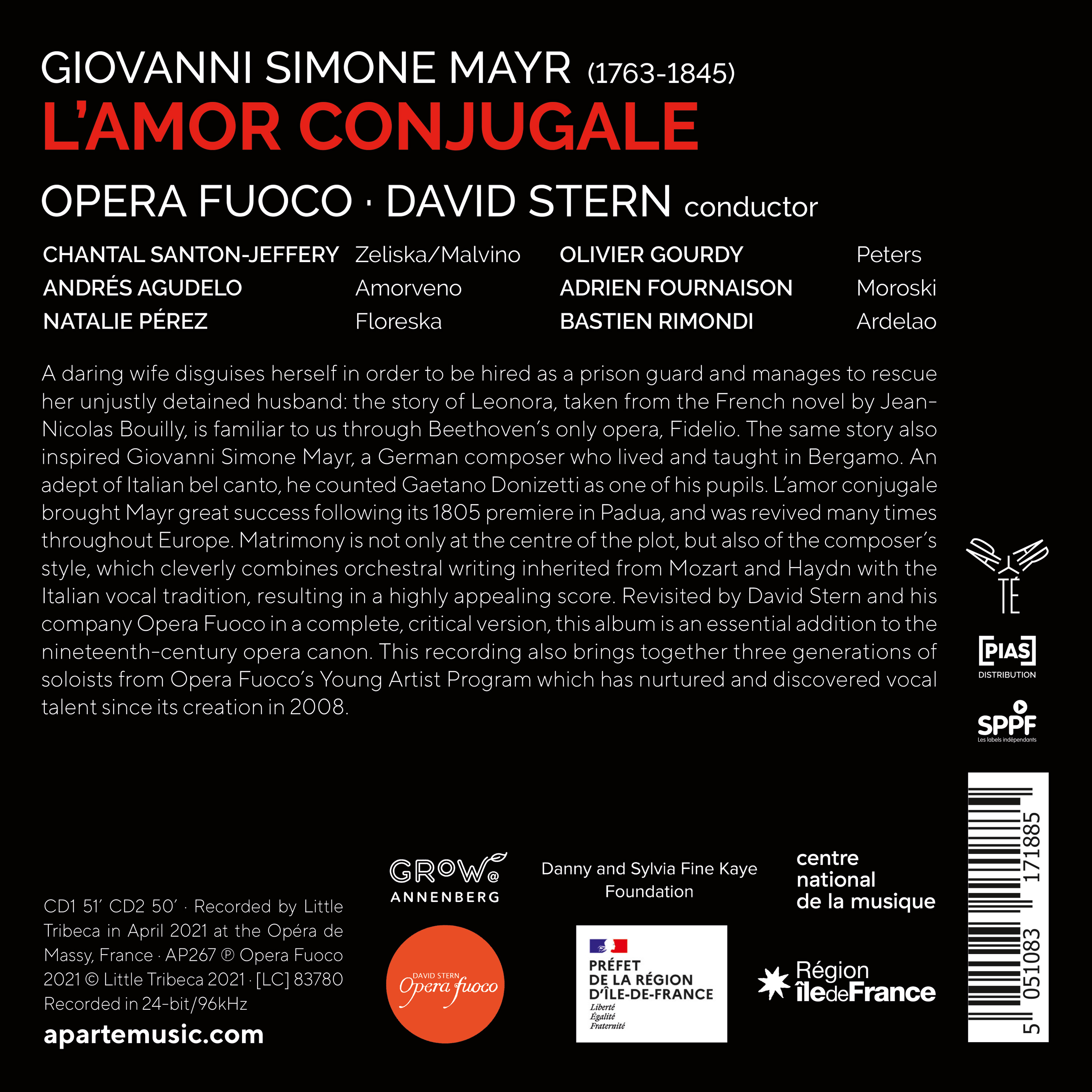
A daring wife disguises herself in order to be hired as a prison guard and manages to rescue her unjustly detained husband: the story of Leonora, taken from the French novel by Jean- Nicolas Bouilly, is familiar to us through Beethoven’s only opera, Fidelio. The same story also inspired Giovanni Simone Mayr, a German composer who lived and taught in Bergamo. An adept of Italian bel canto, he counted Gaetano Donizetti as one of his pupils. L’amor conjugale brought Mayr great success following its 1805 premiere in Padua, and was revived many times throughout Europe. Matrimony is not only at the centre of the plot, but also of the composer’s style, which cleverly combines orchestral writing inherited from Mozart and Haydn with the Italian vocal tradition, resulting in a highly appealing score. Revisited by David Stern and his company Opera Fuoco in a complete, critical version, this album is an essential addition to the nineteenth-century opera canon. The recording brings together three generations of soloists from Opera Fuoco’s Young Artist Program which has nurtured and revealed vocal talent since its creation in 2008.
GIOVANNI SIMONE MAYR
L’AMOR
CONJUGALE
DRAMMA SENTIMENTALE IN UN ATTO
ITALIAN LIBRETTO BY GAETANO ROSSI
PREMIERED AT TEATRO NUOVO, PADOVA, 1805
1. Sinfonia 7’48
2. SCENA PRIMA
Introduzione (Floreska): Gira, gira, molinello 2’13
3. Allegretto (Floreska, Peters): Vieni quà, vieni quà, figliuola 2’11
4. SCENA II
Accompagnato (Zeliska, Floreska, Peters): Sono quà mia cara, addio 2’42
5. Cantabile (Zeliska, Floreska, Peters): Caro oggetto d’un affeto 2’27
6. Allegro (Zeliska, Floreska, Peters): Io sono allegro, io son contento 2’25
7. Recitativo (Peters, Zeliska, Floreska): Sì Malvino, sta allegro; è già da un pezzo 4’26
8. SCENA III
Recitativo (Peters, Floreska): Sempre più son contento 0’37
9. Aria (Floreska): Non so, cosa sia 1’59
10. SCENA IV
Recitativo (Peters): Quì bisogna sbrigarsi 0’30
11. SCENA V, VI, VII
Recitativo (Moroski): Siate pronti miei fidi / (Peters): Mio Signore /(Moroski, Peters):
Un espresso 0’46
12. Accompagnato (Moroski): Chi mi scrive 0’54
13. Aria (Moroski, Peters): Ciel, che lessi! Qual periglio! 4’41
14. SCENA VIII
Recitativo (Floreska, Zeliska): Lo vedesti? 1’06
15. SCENA IX
Recitativo (Zeliska, Floreska, Peters): Floreska, ritirati 0’35
16. SCENA X
Recitativo (Zeliska, Peters): Lode al Cielo, siam soli 2’06
17. SCENA XI
Scena (Zeliska): Sì, ne profitterò 8’46
18. SCENA XII
Recitativo (Floreska, Peters): Lasciami, che ho da fare 1’06
19. Aria (Peters): L’oro a un colore 4’20
20. SCENA XIII
Recitativo (Floreska): Sarà ver quel, che dice 0’32
21. SCENA XIV
Scena (Amorveno): Qual notte eterna, spaventosa! 6’16
22. Aria (Amorveno): Cara immagine adorata 3’41
23. Accompagnato (Amorveno): Oh Dio, dolce illusione 1’34
24. SCENA XV
Recitativo (Zeliska, Peters): Animo. Ma cos’hai? Paura? 2’25
25. Romanza (Zeliska, Peters): Una moglie sventurata - Prima stanza 2’31
26. Recitativo (Zeliska, Peters): Ma che razza di canzon 0’13
27. Romanza (Zeliska, Peters): Scuopre alfin, che in nera tomba - Seconda stanza 6’39
28. Trio (Amorveno, Zeliska, Peters): Ah! qual voce mi sorprende 4’10
29. SCENA XVI
Quartetto (Zeliska, Amorveno, Moroski, Peters): Fra l’orror di questo abisso! 8’23
30. SCENA XVII
Accompagnato (Zeliska, Amorveno): Ecco tutto perduto! 2’18
31. Duetto (Zeliska, Amorveno): Ah, ti stringo al seno omai 5’19
32. SCENA XVIII
Finale – Sestetto (Zeliska, Floreska, Amorveno, Ardelao, Moroski, Peters):
Vendetta, vendetta 3’32
33. SCENA ULTIMA (Zeliska, Floreska, Amorveno, Ardelao, Moroski, Peters):
Ah, perché non t’apri, o terra 3’35
