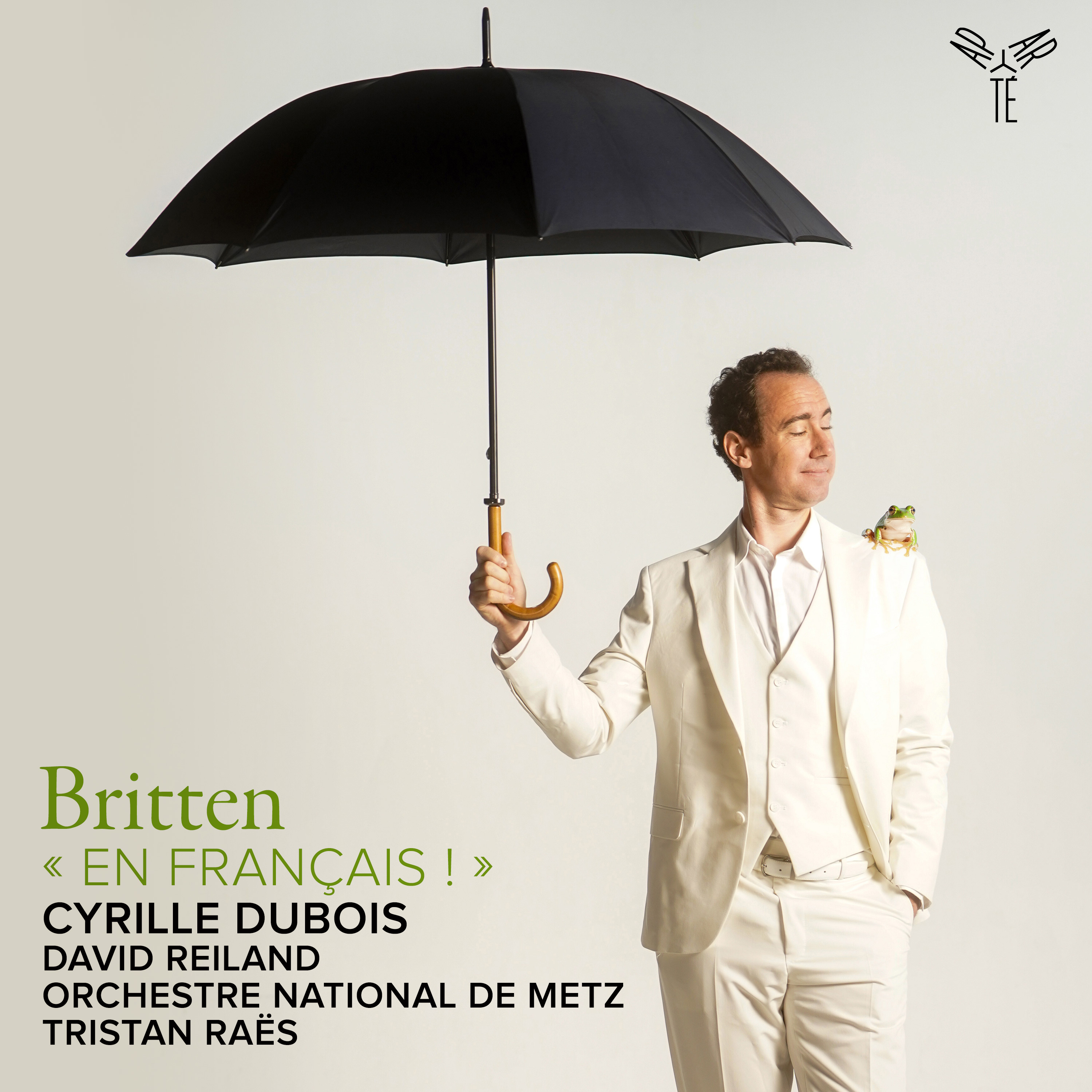
With this new recording, Cyrille Dubois continues his passionate exploration of the French-language vocal repertoire, taking on an unexpected challenge: paying tribute to Benjamin Britten, a towering figure of British music, through his works in French. There is a playful twist to the idea, aimed in particular at the British audiences who have welcomed Dubois as an Artist in Residence at Wigmore Hall, London’s temple of song. Winner of a Gramophone Award in 2023 for his complete recording of Gabriel Fauré’s songs with pianist Tristan Raës, the tenor confirms here his standing as one of today’s foremost interpreters of this repertoire, while broadening his horizons to embrace one of the major figures of twentieth-century English music. The Orchestre national de Metz and its Music Director David Reiland have lent their support to the recording, providing the project with a setting of rare sonic elegance.
The programme brings together three cornerstones of Britten’s French-language vocal output. *Les Illuminations* (Op. 18), composed in 1939 to poems by Arthur Rimbaud, form a strikingly modern fresco for tenor and strings, swept by lyrical impulses and expressionist ruptures. The *Quatre Chansons françaises*, a youthful work written at the age of sixteen to poems by Victor Hugo and Paul Verlaine, reveal an adolescent Britten already possessed of an extraordinary poetic sensitivity, coupled with orchestral writing of astonishing maturity. Finally, the *Folk Songs*, in their French-language arrangements, complete this journey, as Britten approaches popular melodies with the tenderness and refinement that are among the hallmarks of his art.
These three works can be heard as different facets of a single perspective: that of a British composer fascinated by the French language and French culture, absorbing and transcending them to create a voice entirely his own — universal and poetic. Under David Reiland’s direction, the Orchestre national de Metz brings the warmth and precision this repertoire demands, while Cyrille Dubois unfolds the luminous clarity of his timbre, a high tenor voice with a gently amber-hued, honeyed quality, capable of moving from Hugo’s Romantic ardour to Rimbaud’s Symbolist vertigo without ever losing its naturalness or intensity. This recording explores the boundaries between musical cultures, bringing France and England together, for the span of an album, in a shared poetic impulse.
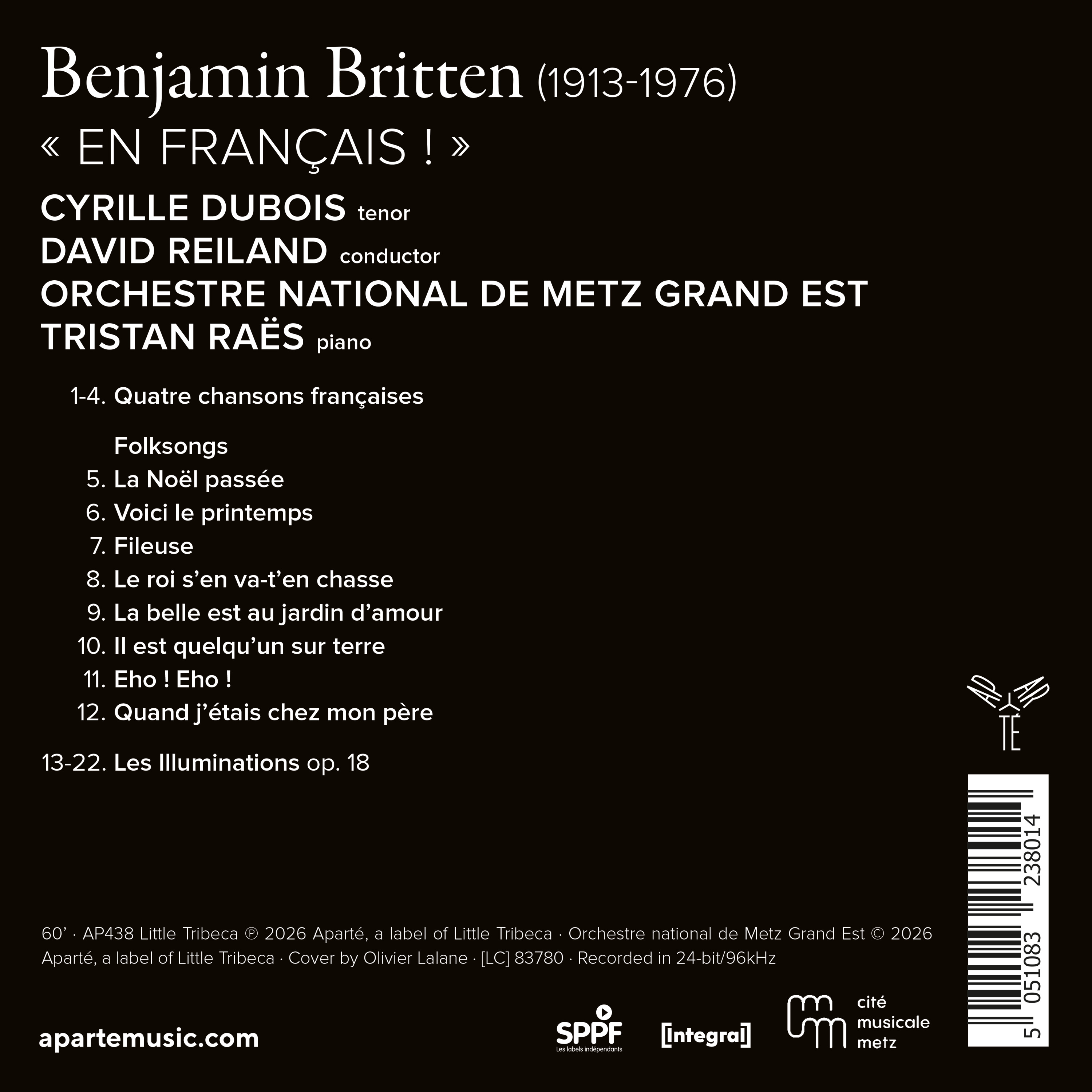
Benjamin Britten (1913-1976)
Quatre chansons françaises
1. I. Nuits de juin 2’37
2. II. Sagesse 2’41
3. III. L’Enfance 4’06
4. IV. Chanson d’automne 2’08
Folksongs
5. La Noël passée 3’59
6. Voici le printemps 1’46
7. Fileuse 1’53
8. Le roi s’en va-t’en chasse 2’13
9. La belle est au jardin d’amour 2’36
10. Il est quelqu’un sur terre 4’39
11. Eho ! Eho ! 1’39
12. Quand j’étais chez mon père 1’50
Les Illuminations op. 18
13. I. Fanfare 1’55
14. II. Villes 2’22
15. III a. Phrase 1’05
16. III b. Antique 2’05
17. IV. Royauté 1’36
18. V. Marine 0’59
19. VI. Interlude 2’32
20. VII. Being Beauteous 3’44
21. VIII. Parade 2’50
22. IX. Départ 2’39

See also